LAZO fomenta diálogo entre artistas que trabajan en Nueva York y en ciudades de América Latina. | LAZO fosters dialogue among artists working in New York and in Latin American cities.
Tatiane Santa Rosa to curate the 24th rendition of Young Latinx Artists exhibition
YLA24 “Buen Vivir/Vivir Bien”: To Radically Live Well Tatiane Santa Rosa
The notion of buen vivir, used by different social movements across Latin America, presents a radical opposition to present-day capitalist social wounds. This decolonial concept has been borrowed from the notion of sumak kawsay of the Kichwa people from Ecuador that Armando Muyolema defines, among other things, as “the attainment of a full life.” In this spirit, the 24th edition of Mexic-Arte Museum’s Young Latinx Artists exhibition, “Buen Vivir/Vivir Bien,” features artists’ practices that enact decoloniality in different ways. The artworks displayed here do not simply document living traditions or illustrate what “good living” should look like, instead, what the participant artists offer us are decolonial ways of imagining, visualizing, and changing the world.
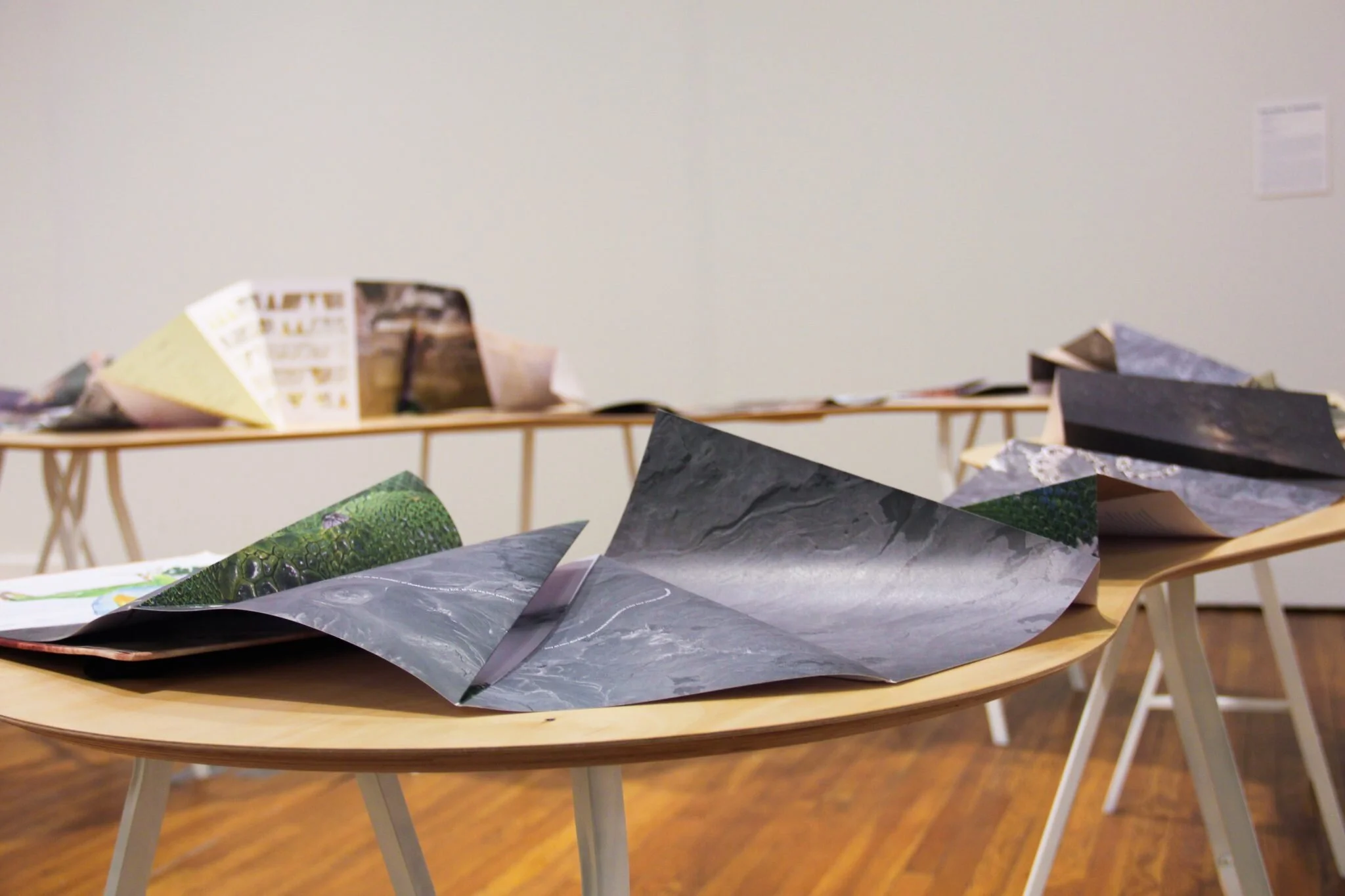
Many artists in YLA24 “Buen Vivir/Vivir Bien” are interested in challenging western hegemonic worldviews that capitalize on divisions such as “nature x culture.” For example, Carolina Caycedo’s on-going series “Be Dammed” is comprised of video documentaries and installations that expose the perverse effects of hydroelectric dams on the lives of riverine and indigenous peoples across Latin America. In Land of Friends (Tierra de Amigos) (2014), Caycedo documents the area of the Yuma river in Colombia and interviews members of the communities affected by El Quimbo Dam project. Caycedo’s meandering installation Serpent River Book (2017) brings the river to the gallery space, associating this water body with the knowledge inherent in the format of ancient Mesoamerican codices.
Also interested in breaking with western notions of nature, Bel Falleiros’ practice involves creating solid connections between art, communities, and place. In this exhibition, Falleiros shows a series of research drawings on concentric ancestral buildings, as well as the video performance The Eye of the Earth (2019) in which she reinterprets Inhampabuassu which, from Tupi-Guarani language, is the name of the primal knoll where her home town, São Paulo, was founded. While Falleiros researches on the relationship between landscape and the woman’s body, Lina Puerta’s practice revolves around nature in a different way. Known for her visually mesmerizing sculptures and paper pulp tapestries, Puerta presents here a series of farmworkers’ portraits that she selects from found imagery on the Internet. Invisible behind the capitalization of their harvest, farmworkers are one of the most vulnerable Latinx groups living across the US; in these paintings, Puerta gently involves these figures in delicate adornments inspired by the crops they work with.
Thinking of non-humans and nature as social entities is part of Yareth Fernández’s practice. Fernández focuses on site-specific installations that through complex geometries and abstraction refer to a combination of real landscapes, sci-fi narratives, and indigenous spiritual concepts. Fernández’s recent works, such as those displayed in her solo exhibition El Muro y el Ocelote, represent the US-Mexican border not only as a wound on people’s lives but also as a scar on the ecosystems in which it has interfered. While Fernández’s work shows us that the concept of fixed borders does not exist in nature, the violence behind the idea of national borders is also present in Fernando Poyón’s work. In Usos alternativos de bandera (Alternative Uses of a Flag) (2016) the artist applies tiny national flags as ornaments for an empty birdcage. Born in Comalapa, Guatemala, a Kaqchikel community, Fernando is sensible to the indigenous peoples’ struggles in his country, but also to Central and South American populations’ hardships, such as the xenophobic, racist, reactions these populations have to face when they migrate or seek refuge in the US.
Another group of artists in the YLA24 “Buen Vivir/Vivir Bien” engages in decoloniality by re-reading precolonial indigenous visual vocabularies. Also from Comalapa, Guatemala, Ángel Poyón shows his Estudios del Fracaso Medidos en tiempo y espacio (Studies in Failure Measured in Time and Space) (2008), in which he replaces the displays of mechanical alarm clocks with line combinations that look like complex pathways. In doing so, Ángel may be referring to Mayan indigenous notions of measuring time, or the mapping of complex movements through space, but also to geometric abstraction. In fact, late twentieth century’s geometric abstraction made by Latin American artists has been hailed across the art world, but these practices have been often framed as re-interpretations of European artistic avant-gardes. Not unlike Ángel Poyón’s interests, Ronny Quevedo’s works interrogate hegemonic narratives on abstract art by reminding us that geometric abstraction has always been part of indigenous cosmogonies across the Americas. In his practice, Quevedo juxtaposes Incan and precolonial South American cultures’ visual elements, such as tunic patterns, with his own community’s histories of migration.
While Quevedo embeds contemporary abstraction back into its ancestral qualities, in Mauricio Cortes Ortega’s works colonial crowns become colorful sarape-inspired figures. Sarape textiles are geometric patterned textiles, often worn as ponchos and produced since the seventeenth century in Saltillo, a town in northern Mexico. Like so much of Mexican culture since colonization, sarapes are the result of centuries of blending of Native American and European traditions. Cortes’ “sarape-ed-crowns” suggest the persistence of an indigenous hand, as well as speak of indigenous peoples’ and their objects’ histories of displacement. In a similar move, for the series Parangaricutirimicuaro (2018), Alva Mooses melted pendants with the image of the Virgin San Juan de los Lagos and photographed the resulting objects. The work’s title refers to the San Juan village’s nickname, Parangaricutirimícuaro. This village was destroyed in 1943, after the Parícutin volcano erupted but some believe the village never existed. In Mooses’ images, the delicate head of the Virgin is liquefied, suggesting running-lava from a volcano.
Two artists in the YLA24 “Buen Vivir/Vivir Bien” decolonize art making by turning their gaze towards the African Diaspora and the Black Atlantic. Through her practice, Joiri Minaya interrogates the history constructed by the western white male subject in the shaping of the category “tropical” and in the objectifying of Black and Brown women’s bodies. In Redecode a tropical theme is a great way to create a fresh, peaceful, relaxing atmosphere (2015), Minaya invites visitors to explore with their smartphones a tropical pattern mural that makes us re-think certain stereotypes around Caribbean and Latin American cultures. On the other hand, Dalton Paula is interested in the invisibility of the Black subject in Brazil and across the African Diaspora. The silenced body––as Paula calls the characters that appear in his video performances––is the Black body that has been erased or undermined in Brazilian society. Paula enacts symbolisms whose African roots have gone often unacknowledged or overlooked in history. In the videos Unguento (Ointment) (2013) and Implantar Anamú (To Implant Anamú) (2016), Paula reclaims Afro-Latinx and Afro-Brazilian healing knowledges connecting past and present.
Is it possible to live well while the world crumbles around us? What does it mean to live well in a world that push us to be productive and to succeed at each step we take? As a Brazilian-born proudly Latina woman living in the US, I ask myself these questions numerous times a day. For many non-normative US-Latinx people and non-normative Latin Americans, to live well is often unattainable, while for some of us “a good living” may be even overlooked. Perhaps what this exhibition invites us to consider is that through buen vivir/vivir bien we may find wisdom, action, and healing in the knowledges and experiences of our own diverse communities. It may be possible to vivir bien if we seek to practice decoloniality day by day: in our trivial actions but also considering decoloniality as part of our lifegoals and dreams. We shall insist, despite everything, on claiming our right to live, and our right to live well.